
Sustainability Report 2025
Impact Agency Fabrik
Are you reacting – or driving impact?
The year 2025 was, in many ways, a turning point for corporate sustainability efforts. Although the global political climate became increasingly unstable — and partly for that reason EU regulation at times appeared uncertain and inconsistent — the expectations of consumers and stakeholders did not ease.
The year 2025 was, in many ways, a turning point for corporate sustainability efforts. Although the global political climate became increasingly unstable — and partly for that reason EU regulation at times appeared uncertain and inconsistent — the expectations of consumers and stakeholders did not ease.
Companies are increasingly expected to demonstrate, in a verifiable way, how they create impact not only for shareholders and employees, but also for the wider society and the environment around them. At the same time, the business environment continues to change at an accelerating pace, and further refinements to regulation can be expected.
In this context, sustainability is not an either–or question between compliance and competitiveness. It is unquestionably both. At its best, the term “sustainability” encompasses strategic decision-making, the strengthening of trust in a brand, and the ability to build resilient long-term growth.
At Fabrik, we believe that change does not happen through a single hero, one strategy, or an isolated campaign. Change happens when people, teams, and organizations dare to evolve.
Stories play a central role in this. They shape our understanding of what change looks like — and who gets to be part of it. When we tell stories about collaboration, partnerships, and clear accountability, we make sustainability something people can connect with, not merely something to be measured.
Sustainability work should be approached like the best conversation you have ever had: with curiosity, with the willingness to listen, and with openness to revising your own perspective. Corporate responsibility is not a finished model, but an ongoing process of learning and development that rewards persistence over time.
Welcome to read our review of 2025. It follows the VSME approach and takes into account the principles of the CSRD as applied in an office-context environment. This review is not a perfect measurement of everything, but an honest reflection of where we create impact — and where we still have work to do.
Perttu Kouvalainen
Chief Executive Officer
Fabrik in Brief
Impact Agency Fabrik
Fabrik provides strategic sustainability, branding, concept development, communications, and marketing services. Its value creation is built on long-term partnerships in which sustainability is integrated into the core of business and competitiveness. Our clients represent a wide range of industries, including manufacturing, fashion, energy, construction, and technology. Fabrik is Finland’s first impact agency to combine sustainability and reputation work in a new and integrated way.
Highlights from 2025:
55
Customers
8
New customers
563
Projects
1,7 M€
Revenue
5,13/6
“I feel committed to my work and my employer.”
+80
Customer NPS
1996
Founded
2022
Registered as an Impact Agency
5
B Corp companies consulted (2022–2025)
Helsinki
Pride
Pro Bono Partnership
89
Participants at the “Silence Is Not a Strategy” summit, organized together with Marketing Finland
Abloy, Kamux and Helsinki Central Railway Station
Some of our largest clients
New clients:





“From the very beginning of our collaboration, Fabrik has led our project with clarity and expertise. The work has included a double materiality assessment covering the Nordics and Baltics, as well as our first sustainability report. We have gained many new perspectives and ideas for both our practical sustainability work and our sustainability communications.”
— Henrika Peltola, Danone
How does Fabrik create positive impact?
B Corp Declaration of Interdependence
Our vision is an economy in which business serves as a force for good. This economy is made up of a new kind of company — B Corporations — that are purpose-driven and create value for all stakeholders, not only shareholders. As B Corporations and leaders of this emerging business movement, we believe:
- That we must be the change we wish to see in the world.
- That all business ought to be conducted as if people and the environment truly mattered.
- That through their products, practices, and profits, businesses should aspire to do no harm and benefit all.
- That to achieve this, we must act with the understanding that we are each dependent upon one another and therefore responsible for one another and for future generations.
Double Materiality Assessment
Double materiality assessment means that sustainability topics are examined from two perspectives. Impact materiality describes the positive or negative impacts Fabrik’s operations have on people, the environment, and society. Financial materiality, in turn, describes how sustainability-related issues may affect Fabrik’s business, risks, opportunities, and long-term value creation. A topic is considered material if it is significant from either perspective — or both.
In 2025, Fabrik updated its double materiality assessment, which was originally conducted in 2023. The purpose of the assessment is to identify the sustainability topics that are most material to Fabrik from two perspectives: how our operations impact people, the environment, and society, and how sustainability-related issues affect Fabrik’s business, competitiveness, and long-term value creation.
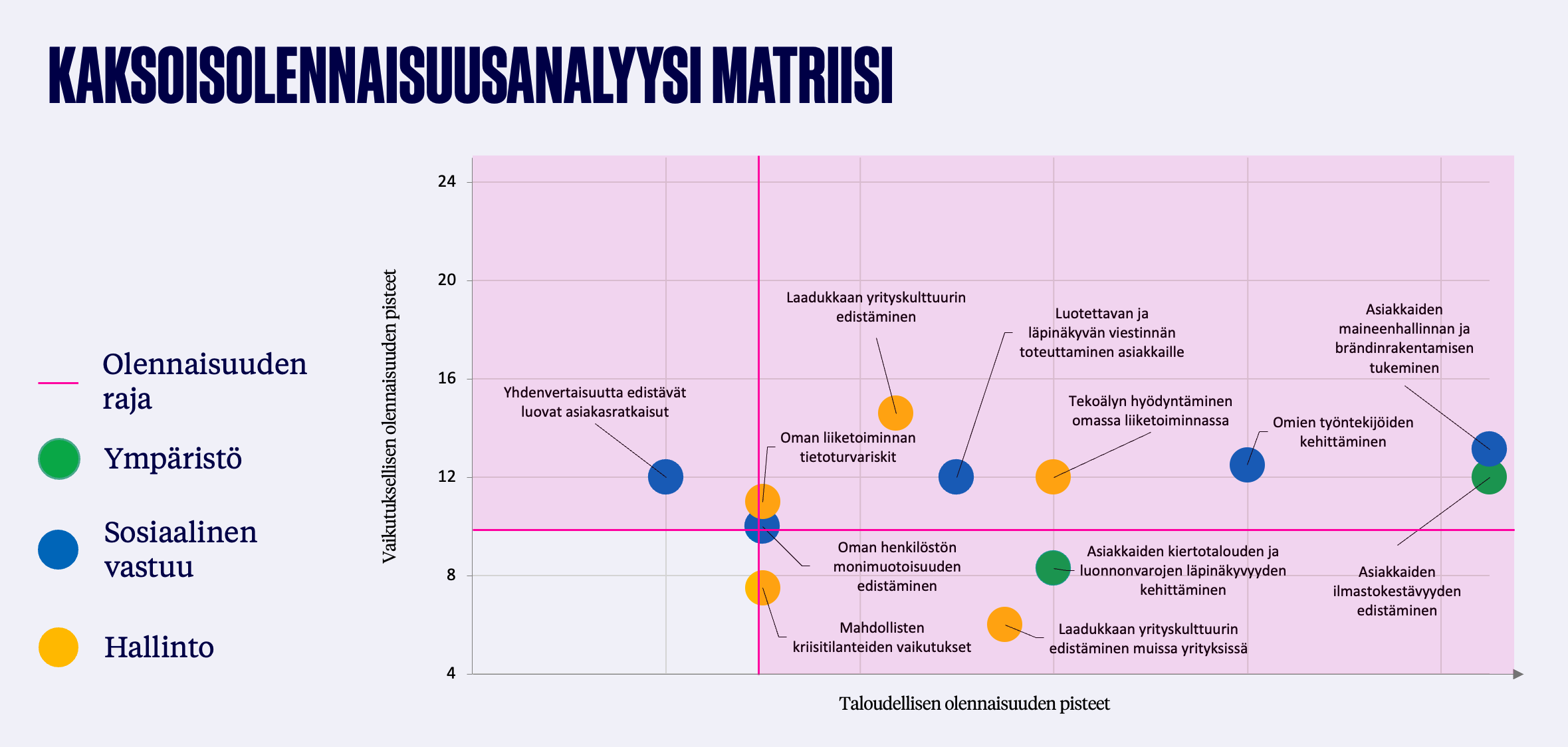
The update was based on Fabrik’s ownership and business strategy, the nature of its client work, and the perspectives of key stakeholders. Governance, clients, partners, and employees all participated in the assessment process. The results have been compiled into a double materiality matrix, where the horizontal axis represents financial materiality and the vertical axis represents impact materiality. The closer a topic is positioned to the upper right corner, the more material it is to Fabrik from both perspectives.
Environment – impact through clients
Due to the nature of Fabrik’s office-based business operations, the direct environmental impacts of our own activities are limited. Therefore, our most significant environmental impact is created through client work. The most material topics identified were advancing our clients’ climate resilience as well as improving transparency related to circular economy practices and the use of natural resources within our clients’ operations.
Social Responsibility – expertise, diversity, and the impact of communication
Within social responsibility themes, key areas of focus include the development of our employees’ expertise, the promotion of diversity, and the impacts created through client work. The most material topics identified were the development of our own employees, fostering diversity within our workforce, providing people- and customer-centered strategic expertise, creating client solutions that promote equality and inclusion, and delivering reliable and transparent communications for our clients.
Governance – culture, trust, and capacity for renewal
Within governance-related themes, the focus is on the quality of our own operations and the foundations for responsible growth. The most material topics identified were fostering a high-quality corporate culture within Fabrik, supporting the development of strong corporate cultures in other organizations, helping clients manage reputation and build their brands, managing information security risks within our own business operations, leveraging artificial intelligence in our business, and addressing the potential impacts of crisis situations.
Boundaries and assumptions: The assessment does not cover the impacts of our clients’ entire value chains, but instead focuses on the impacts, risks, and opportunities arising from Fabrik’s own operations, expert work, and partnerships. Within environmental themes, the primary focus is on the positive impact created through client work, as Fabrik’s own direct environmental impacts are relatively limited.
Transformation of our clients’ businesses
Fabrik supports sustainability as a holistic strategic choice and encourages its clients to extend their efforts beyond reporting and compliance toward broader, long-term transformation.
The focus of our client work is on handprint impact: how our clients enable positive change. Impact is created when words turn into actions and communications support genuine transformation.
Our work supports positive environmental impact, for example through:
- Calculating and making emission reductions visible
- Communicating resource efficiency
- Building understanding of the circular economy
- Supporting the acquisition of certifications (B Corp, EcoVadis, SBTi)
Our work supports social and societal impact, for example through:
- Developing a responsible corporate culture
- Supporting thought leadership from a societal perspective
- communications related to employer branding and societal campaigns
Case
Sako
“With Fabrik, our sustainability efforts moved from paper into practice —”
“— now it supports the entire business and helps us respond to our customers’ expectations.”
— Niina Saari, Communications Manager at Sako
Getting sustainability work started in a clear and inspiring way
Sako Oy wanted its sustainability efforts to achieve more than merely compliant reporting. Sustainability needed to guide decision-making, everyday operations, and strategy, while progressing consistently alongside the company’s significant business growth.
We launched a structured and dynamic ESG partnership. The collaboration, which began in 2024, continues as a close partnership focused on advancing sustainability in a comprehensive and holistic way.
Impact of the collaboration:
- A unified vision, storytelling approach, and governance model for sustainability
- Metrics that support decision-making and efficient data collection
- A concrete roadmap and practical day-to-day support
- Sustainability Review 2024, an ESRS-aligned Sustainability Report 2025, and the preparation of the first report intended for public distribution
- Organizational understanding of and commitment to holistic sustainability work and its opportunities
Case
Kekäle
“Fabrik has played an important role in Kekäle’s long-term and holistic transformation — not only as a strategic and creative partner, but also in the execution of concrete initiatives. Our projects together have covered all of our ESG themes extensively, and even beyond.”
— Joonas Kekäle, CEO of Kekäle
A small family business aiming for major change

Kekäle is a Finnish clothing retail pioneer and a family business that has been doing determined work for a more responsible fashion industry as Fabrik’s partner since 2022.
The goal is not merely to meet sustainability requirements, but to reshape the thinking of the entire industry and guide consumer behavior toward more sustainable choices: buying less, using products longer, and making better-informed decisions. The aim is to steer customers away from disposable consumption and toward timeless, well-loved clothing and long-lasting choices, while also developing the company’s own product selection and collaboration with partners in a more sustainable and transparent direction.
One of the biggest themes in their sustainability work is the B Corp certification achieved in 2023. Certified B Corp companies are leading actors in a global movement whose goal is an inclusive, fair, and regenerative economy.
Impact of the collaboration:
- Refining the sustainability program and communications around the philosophy of “the most loved clothes”
- Turning sustainable consumption into the campaign narrative “How Much Is Enough?”
- Integrating VSME reporting into the sustainability program as a clear, lightweight, and updatable framework
Case
Steissi
“Helsinki Central Railway Station is part of the Finnish cultural landscape — a symbol around which people gather, move, and pass through, serving as a gateway between the past and the present. The projects carried out together with Fabrik demonstrate how cultural heritage can be renewed and brought into the present day in innovative ways that resonate with both people’s hearts and society as a whole.”
— Jani Jääskeläinen, Development Director of Helsinki Central Railway Station
The revival of a culturally and historically significant national treasure
Helsinki Central Railway Station, with nearly 300,000 daily users, is Finland’s busiest building. A partnership initiated several years ago includes a brand and sustainability strategy aimed at transforming the station from a transit point into a destination where people want to come and spend time.
During the collaboration, the value of the station has developed significantly. A key focus of the partnership has been the advancement of social responsibility, with the goal of creating a safer station for everyone and positioning the space as a culturally and historically significant destination.
In 2025, the most visible initiative was an inclusive campaign focused on renewing cultural heritage, which brought the conservation process of Eero Järnefelt’s Landscape from Koli into contemporary national conversation. The campaign received the Wow Award at the Finnish Comms Awards 2025.

Impact of the collaboration:
- The role of the station evolved: Helsinki Central Railway Station transformed from a place of transit into an active urban destination where people spend time, connect, and experience culture.
- Social responsibility became tangible: the campaign strengthened the station’s sense of safety, accessibility, and identity as an open, shared space for everyone.
- Cultural heritage was brought into the present day: its historical value was not left as a museum-like backdrop, but instead transformed into a living and participatory part of contemporary life.
- The intangible value of the station increased significantly: the strengthening of its attractiveness has been reflected in improved tenant agreements and an increase in the building’s estimated value relative to the investments made.
- Broad visibility without a heavy media budget: nationwide media attention, the involvement of cultural influencers, and active public participation demonstrated the impact of values-driven content.
Sustainability goals and metrics
Fabrik’s own environmental footprint is limited
Our real impact is created through our clients. We act as a catalyst: helping clients identify the sustainability topics that matter most, set meaningful goals, and communicate them in ways that guide actions and decision-making.
Impact agencies influence companies especially through their:
- sustainability and strategy work
- the integration of sustainability into sales and marketing
- building understanding and commitment
Value chain:
01
Companies’ business operations
→
02
Fabrik’s expert work
Partners often involved
→
03
Clients’ strategies and communications
→
04
Actions and initiatives
→
05
Impact
Societal and/or environmental impact
Environment
Our goal is for every active client to have a climate program.
- Impact of client work
- Management of emissions from our own operations
Fabrik is committed to supporting the 1.5°C target of the Paris Climate Agreement. Due to the nature of our business, the emissions from our own operations are relatively limited. Therefore, our greatest potential for impact is created through client work: helping companies build measurable climate and environmental programs, roadmaps, and monitoring models that are directly integrated into the core of their business.
Impact of client work
- Our goal is for every active client to have a climate program — either an existing one or one developed in collaboration with us.
- Climate programs should include, at a minimum, a current state assessment, targets, a roadmap, and monitoring.
- Climate or environmental objectives, along with at least one measurable indicator, are integrated into projects whenever applicable.
- We strengthen expertise through internal training sessions and workshops designed for clients.
Management of emissions from our own operations
- We calculate our carbon footprint annually (Scope 1–2 as well as relevant Scope 3 categories, such as travel and procurement).
- We publish a summary of the results and identify concrete opportunities for emission reductions.
- We prioritize remote and rail alternatives when making travel decisions.
- We continuously develop our procurement and operating practices in accordance with the principle of continuous improvement.
The implementation of the climate and environmental program is overseen by the CEO. Practical coordination and KPI monitoring are managed by a designated sustainability lead, and progress is reviewed at least annually as part of management review processes.
The program is updated at least every three years, or earlier if significant changes occur in the operating environment or business operations. The perspectives of stakeholders — including employees, clients, and partners — are incorporated into the ongoing development of the program.
Social Responsibility
Over the past few years, we have made significant progress in managing workload and improving the anticipation and planning of work.
- Well-being at work and resilience
- Competence development
- Equality and culture
Goals for 2026–2028
- Average employee engagement score of at least 5.5 / 6
- Sick leave below 8 days per employee per year
- Balancing the gender distribution of personnel (40–60%)
- 100% of employees participate in at least one competence development program annually
Highlights from the employee survey 12/2025:
“Fabrik is constantly moving forward, which means it’s impossible to become stagnant in your professional development as an employee. Best of all, you can genuinely influence both the direction and pace of that development yourself.”
“Encouraging, meaningful, and exceptionally enjoyable.”
“Our work community consists of a relaxed, knowledgeable, efficient, and inspiring group of people who genuinely want to work toward a better future.”
Good governance
We are committed — even through our Articles of Association — to the principle of “Using business as a force for good,” meaning the use of business as a driver for positive impact.
- Transparent operating practices
- Ethical principles
- Partnerships and B Corp certification
- AI practices
VSME data points
We use the VSME reporting framework below to present our sustainability-related information. Through it, we describe our operations from the perspectives of environmental responsibility, social responsibility, and good governance (ESG) as clearly and concisely as possible.
This version includes the disclosures required under the VSME Basic Module (B1–B11). The Comprehensive Module disclosures may be added later as a separate extension.
B1 Basis for preparation of the report
The report has been prepared in accordance with the disclosure requirements of the Basic Module of the Voluntary Sustainability Reporting Standard for SMEs (VSME). The report applies to Impact Agency Fabrik Oy, operating in the field of management consulting (70200). Further information about the company can be found in the section Fabrik in Brief.
B2 Policies, practices, and initiatives for the transition toward a more sustainable economy
Further information about Fabrik’s impact objectives and methods can be found in the section How Fabrik Creates Positive Impact.
B3 Energy and greenhouse gas emissions
Information regarding energy use, emissions, and related reduction targets can be found in the section Environment.
B4 Pollution of air, water, and soil
The consulting business does not generate significant direct emissions to air, water, or soil, and the company is not legally required to report on them.
B5 Biodiversity
Fabrik’s offices in Helsinki and Joensuu are located in the city centers and are therefore not situated in or near areas considered sensitive in terms of biodiversity.
B6 Water
Information regarding water consumption can be found in the section Environment.
B7 Resource use, circular economy, and waste management
Information regarding waste volumes can be found in the section Environment.
B8 General information about the workforce
B9 Occupational health and safety
Information on measures taken to promote employee well-being and resilience can be found in the section Social Responsibility.
B10 Compensation, training, and collective agreements
Information regarding employment contract types and training volumes can be found in the section Social Responsibility.
B11 Convictions and fines related to corruption and bribery
Impact Agency Fabrik Oy did not receive any convictions or fines related to corruption or bribery during the reporting year. Information regarding the company’s ethical principles can be found in the section Good Governance.